
| Client: Gleeson Land Ltd |
| Sector: Residential |
| Location: Southwest Aylesbury, Buckingham |
| Disciplines: Air Quality |
Overview
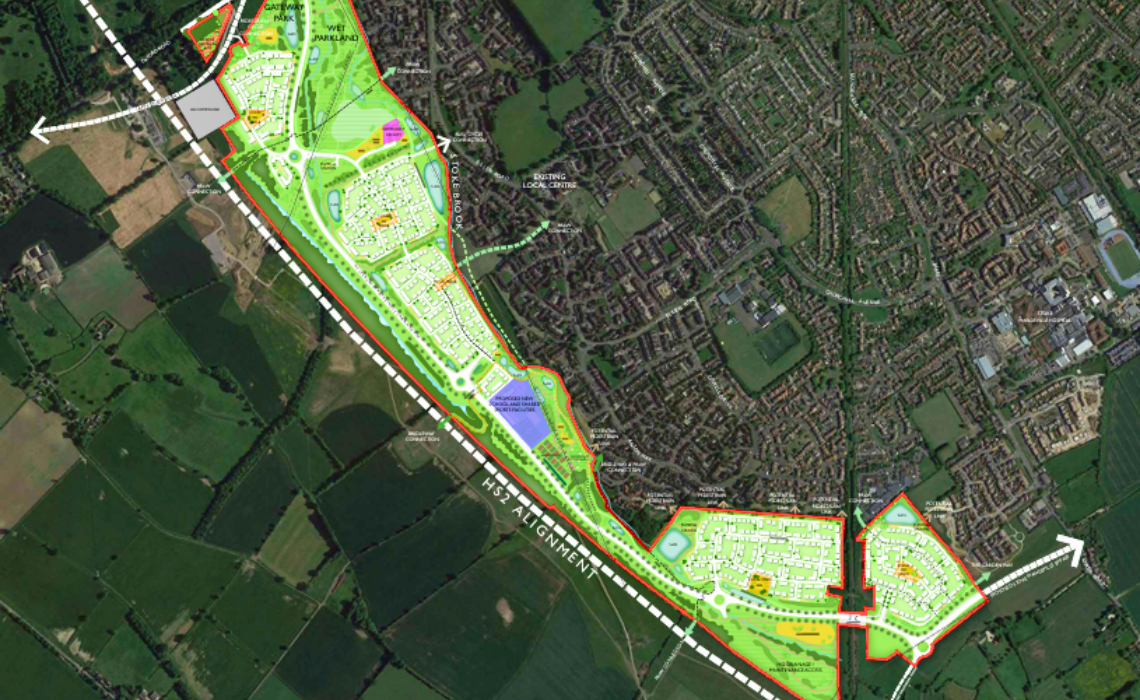
MEC were commissioned by Gleeson Land Ltd to support the development at Southwest Aylesbury by providing an Air Quality Assessment.
The site is located approximately 1km west of Aylesbury Town Centre and comprises greenfield land, bordered by existing residential development to the east and the proposed Phase One route of HS2 along the western boundary.
Outline planning permission has been secured for the construction of up to 1400 new homes, a primary school, a community building, five Gypsy and Traveller pitches, and a multi-functional green space to form the Southwest Aylesbury Urban Extension. The wider proposals also include the Southwest Link Road, walking and cycling links, flood attenuation measures and associated infrastructure works.
Overview of MEC Services
Our Air Quality team were appointed to provide specialist environmental input to examine the impact of development traffic road emissions from the site upon existing and future sensitive receptors. The key traffic-related pollutants considered are nitrogen dioxide (NO2) and particulate matter (PM10).
The assessment considered both existing conditions and future year scenarios, including the cumulative effects of committed development and the proposed Southwest Link Road. The assessment results indicate that annual mean NO2 and PM10 concentrations are predicted to reduce in some areas and increase in others. However, pollutant concentrations across all assessed scenarios remain below national air quality objectives, confirming the site is suitable for residential development.
Since the Air Quality Assessment indicates that the annual mean air quality objective will be met at the most exposed receptor locations with the new development in place, and since the actual changes due to traffic generated by the new development are small, it was concluded that the air quality impact from the proposed development will not lead to a significant impact on existing air quality.
Although mitigation is not strictly required, measures have been proposed to minimise the potential effects associated with increased air pollutant concentrations. The mitigation measures include electric vehicle charging in accordance with guidelines, low Nox heating and boilers, Travel Plan measures, and improvements to walking and cycling connectivity to support more sustainable travel choices.
The assessment also reviewed construction phase impacts, with regard to dust soiling, the risk assessment indicated that in the absence of mitigation, the earthworks, construction and track-out phases would present a ‘High Risk’. Mitigation measures include ensuring machinery and dust causing activities should be located away from sensitive receptors, construction traffic should be controlled (such as ensuring all loads entering and leaving sites should be covered), using water as a dust suppressant with demolition works, minimising dust generation activities, and appointing a site agent whose contact details are provided to the LPA’s Environmental Health Department and local residents prior to the construction work starting.
For further information about our services, please click here.