
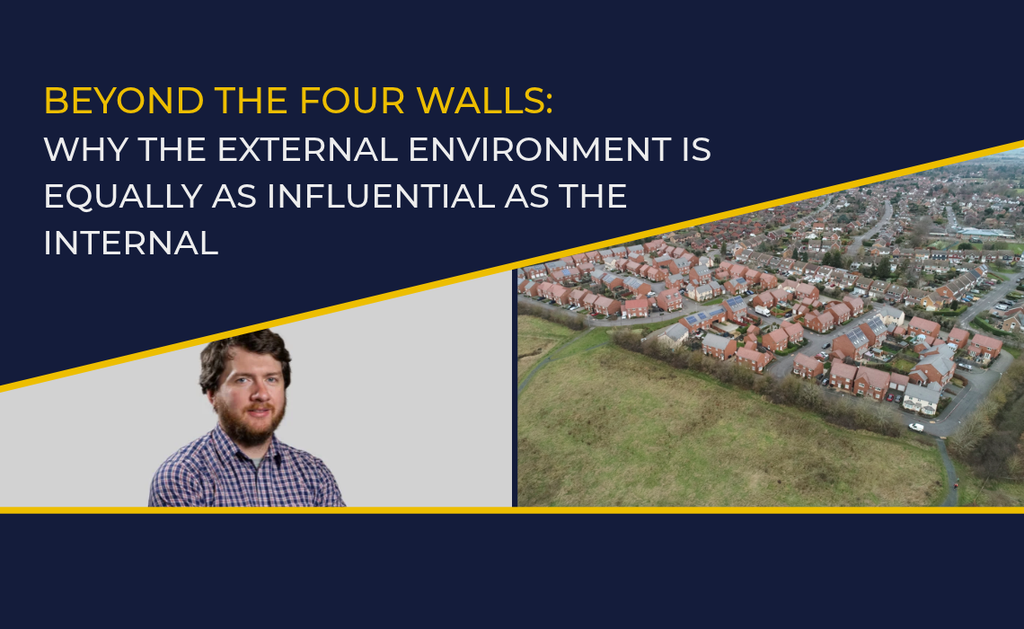
While conversations around air quality typically focus on conditions inside the home, the external environment is equally influential. What should housebuilders consider when it comes to air quality assessment and when? Our Senior Acoustic and Air Quality Consultant, explains
At site appraisal stage, it is important for housebuilders to consider how future residents might be exposed to air pollution. Air Quality Objective Levels, set by DEFRA (Department for Environment, Food and Rural Affairs), provide an industry standard and if pollutant concentrations are predicted to exceed these, site viability could be compromised.
So what pollutant sources do we look for?
The main source of emissions is impact from road traffic, which primarily consists of nitrogen oxide (NOx), nitrogen dioxide (NO2), and particulate matter (PMs) 10 and 2.5. But there is also proximity to industrial/waste management activity, railways and agriculture sites, which have the potential to cause health issues for future receptors.
Assessing and monitoring these emissions at feasibility stage can be a determining factor on site suitability. Sites that are located away from major roads or other high polluting sources will typically have better air quality and therefore be preferable for development. However this does not mean we discount dense, urban or brownfield sites, as early assessment of these will allow for mitigation measures to be incorporated into the initial design.
Types of assessment
Our starting point for any proposed development is a background air quality assessment. This typically combines information from local authority monitoring, DEFRA background concentration maps and the UK emissions mapping. We use this data to examine existing air quality conditions and conclude if further work, such as monitoring or dispersion modelling, is required. The latter may also be the case if adequate information is not available to begin with.
The location, size and type of development determine the level of air quality impact assessment. For the majority, we will scope our assessment alongside local authority guidance and following the two-stage process as outlined by Environmental Protection United Kingdom (EPUK) and the Institute of Air Quality Management (IAQM).
Stage 1 is based on the development size. Anything over ten units means an impact assessment is required but the overall scale of the proposal, factoring in the likely change in emissions, existing air quality and the proximity of sensitive receptors, will affect whether this is simple screening assessment or a more detailed assessment using dispersion modelling.
Stage 2 examines the impact of the proposed development based on changes such as traffic flow and speeds. It is worth noting here that some local authorities have their own preferred guidance, methods of assessment and mitigation, so this needs co-ordinating upfront to avoid timely and costly delays.
Air quality monitoring is another measure that some local authorities request when existing data is limited and should be agreed when the assessment scope is first established. This will examine existing conditions, usually over a 12-month period as pollutant concentrations vary seasonally and can be used to support or verify dispersion modelling. The duration and number of monitoring locations depends on the site, available evidence and collaboration with the local authority, so it is advisable to engage early.
Finally, housebuilders should also consider odour and dust assessments, for both pre-planning stage and during construction. These will evaluate intensity and size of the source, any existing mitigation, prevailing wind directions, and outline any necessary remedial works.
Mitigating for elevated concentrations
If elevated concentration levels are identified at a proposed development or existing receptor locations, such as housing, then mitigation measures need to be introduced. Obviously, this varies depending on the type and scale of development but the best form of mitigation would be at source. However, this is not applicable for road traffic. Alternative solutions therefore include increasing the distance between the receptor and source, allowing for greater dispersion and dilution. Or increasing the amount of vegetation and landscaping, but the impact of this is hard to quantify.
If pollutant concentration persists, or the above solutions are not viable, then we need to look at mechanical ventilation options. These typically use filters to reduce the concentrations internally or allow for ventilation inlets to be positioned on facades away from the source, meaning air can be drawn from cleaner parts of the development.
Housebuilders are advised, however, that these options are only likely to be accepted by local authorities in areas where development is highly desirable, where there are no proposed external amenity areas, and all other viable options to reduce emissions have been undertaken.
One final method we will consider is if pollutant concentrations are high enough, the development might require a closed window strategy. This is always a last resort, but if necessary, mechanical ventilation can be specified to provide background, purge and cooling ventilation for occupants, all in line with Approved Documents F and O.
All these mitigation measures demonstrate why it is important to commission air quality assessments as early as possible, ideally at pre-planning stage before a site layout is fixed. Identifying potential exceedances at the start allows for greater flexibility in the design process and helps to avoid late-stage redesign or retrofit, which can be costly.
A multi-disciplinary approach
In our experience, air quality assessments predominantly focus on the impact of road traffic emissions, so housebuilders are advised to undertake these alongside noise surveys. Roads with high traffic flows may also trigger mitigation requirements, such as stand-offs, barriers and closed windows.
Considering these collectively could result in a more unified mitigation strategy, representing potential time and cost savings. Similarly, air quality also forms an important part of an Environmental Impact Assessment, particularly where development may influence traffic movements or affect sensitive receptors, so is worth approaching holistically.
For housebuilders and developers, the key should not simply be about achieving a planning requirement but integrating air quality as a design consideration. Early assessment allows potential issues to be identified when there is still flexibility to respond, de-risking projects and helping to establish positive placemaking and healthy homes.