
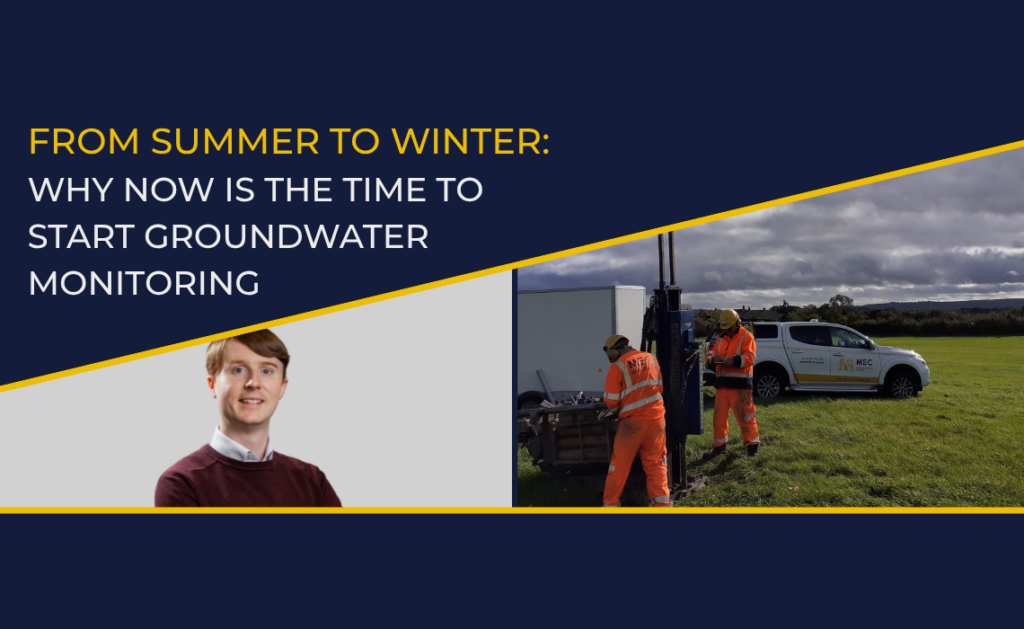
Groundwater monitoring can play an important role in understanding whether infiltration drainage is viable and informing the wider design of a development. However, obtaining meaningful data takes time, particularly where evidence of seasonal groundwater levels is required.
Following a hot and dry summer, high groundwater levels may not be at the forefront of developers’ minds; however, now is an ideal time to install monitoring wells, ready to capture how conditions change as we move through autumn, winter and into spring.
Our Associate Geo-Environmental Consultant, Chris, shares his insights into groundwater monitoring, explaining why starting early can help avoid delays and support better-informed planning and design decisions.
Why is now a good time to start groundwater monitoring?
Following a hot and dry summer, installing groundwater monitoring wells may not feel like an obvious priority; however, putting them in place now means monitoring can begin as conditions become wetter, capturing how groundwater levels respond throughout the Autumn/Winter period. Starting early provides a more representative picture of seasonal conditions and allows the monitoring period to build evidence as groundwater levels potentially rise into winter and spring.
Why is it important to monitor groundwater levels across the wetter autumn and winter months, rather than relying on a single reading?
A single groundwater reading only provides a snapshot of conditions at that particular time. Groundwater levels can fluctuate considerably in response to seasonal rainfall, local geology, drainage conditions and other site-specific factors.
Where infiltration drainage is proposed, Lead Local Flood Authorities (LLFAs) may expect evidence that the highest groundwater levels have been recorded and considered properly. By monitoring the groundwater levels over the winter months and into spring, we can demonstrate how groundwater levels change over time and provide reliable evidence that we have recorded the peak levels for planning and design.
What types of sites or developments are most likely to need groundwater monitoring?
Any site with a potential for shallow groundwater will need groundwater monitoring. This is particularly important for sites where soakaway or infiltration drainage is being considered, as the design must take account of the separation between groundwater and the base of the proposed features. You need to provide evidence that groundwater will not rise to the base of any soakaway or infiltration features. If groundwater does rise higher than anticipated levels, the design, depths or locations may need to change. In some cases, the findings may also indicate that soakaway infiltration drainage is not a viable solution and that an alternative strategy is required.
What can groundwater monitoring tell us, and which planning or design decisions can the results influence?
The results can inform several aspects of a development, particularly the drainage strategy. Shallow groundwater may affect the viability and design of soakaways, while attenuation basins may require additional measures, such as lining, to protect against it. Groundwater conditions can also influence the stability of foundations and infrastructure excavations, along with any other below-ground infrastructure. Understanding groundwater early allows these factors to be considered during design, rather than becoming an unexpected issue once construction begins.
What are the potential risks, delays or additional costs if monitoring is started too late?
Many LLFAs require an understanding of groundwater levels before approving a planning application. Therefore, delays in measuring groundwater levels could result in delays in achieving planning permission. Dealing with unexpected groundwater ingress when construction is underway can result in costly delays whilst alternative excavation solutions are sought. Knowing about the groundwater regime is therefore a crucial part of many developments in the UK.
Starting early provides greater certainty and reduces the risk of groundwater becoming a costly obstacle later in the project.
Why MEC? Plan now, understand later
Installing groundwater monitoring wells early can provide the evidence needed to support planning, drainage and detailed design as a development progresses.
Led by Associate Geo-Environmental Consultant Chris Wall, MEC’s Geo-Environmental team can advise on whether groundwater monitoring is appropriate, establish a site-specific monitoring programme and interpret the findings alongside wider ground investigation and development requirements.
If you are considering a development where groundwater could influence the drainage strategy or below-ground design, speak to our team about putting the right monitoring in place before the wetter months arrive.