
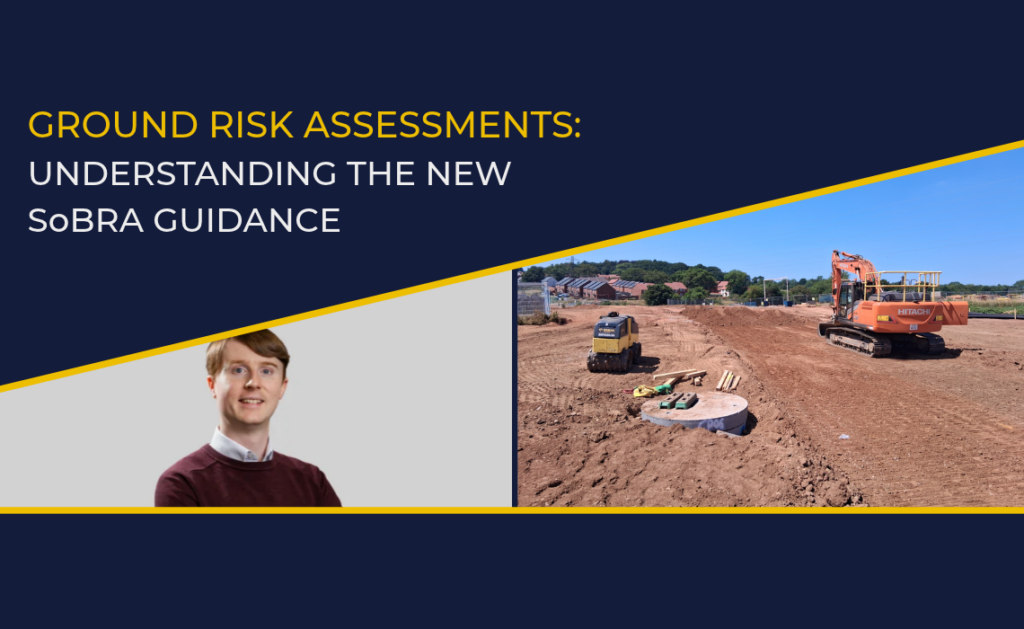
Ground gas risk assessments are an important part of land contamination investigations and quite often involve a programme of ground gas monitoring within borehole installations to assess concentrations of carbon dioxide and methane and determine gas flow rates and the potential for migration to future site receptors. However, the ground conditions and associated gas regime identified during pre-commencement ground investigations may not accurately reflect conditions following construction and associated earthworks.
The new SoBRA guidance aims to ensure that the effects of earthworks are fully considered when preparing and updating ground gas risk assessments, providing a more representative assessment of the potential risks following completion of the works.
Installing additional monitoring wells and undertaking ground gas monitoring following earthworks can be difficult to achieve, particularly as such operations are commonly undertaken as development progresses. Ongoing activities can result in the loss or damage of monitoring wells, whilst the requirement for several weeks or months of monitoring can introduce programme delays. Furthermore, monitoring wells installed within recently placed fill can produce unrepresentative results, including gas concentrations and flow rates associated with short-term changes in ground conditions, rather than the long-term ground gas regime.
The SoBRA guidance recommends adopting lines of evidence to assess ground gas risks, considering how earthworks can alter both gas sources and potential migration pathways. As an example, unsuitable materials containing significant quantities of degradable organic matter are commonly removed, treated, or disposed of as part of site preparation. Changes to site levels and the placement of engineered fill can also alter migration pathways, particularly where cohesive materials are compacted, potentially restricting gas movement.
A range of additional testing and verification techniques can be incorporated into earthworks specifications to provide further evidence of the potential ground gas risk. These include testing of earthworks materials to assess and control organic content (TOC/fTOC), gas generation testing (drum tests), permeability testing and post‑placement surface emission or flux chamber testing to assess potential gas emissions
By considering ground gas risks alongside the design and implementation of earthworks, the new SoBRA guidance provides a more holistic and evidence-based approach to ground gas risk assessment. This can allow the ground gas risk to be reassessed and confirmed without the need for potentially unrepresentative and time-consuming post-earthworks borehole monitoring.