
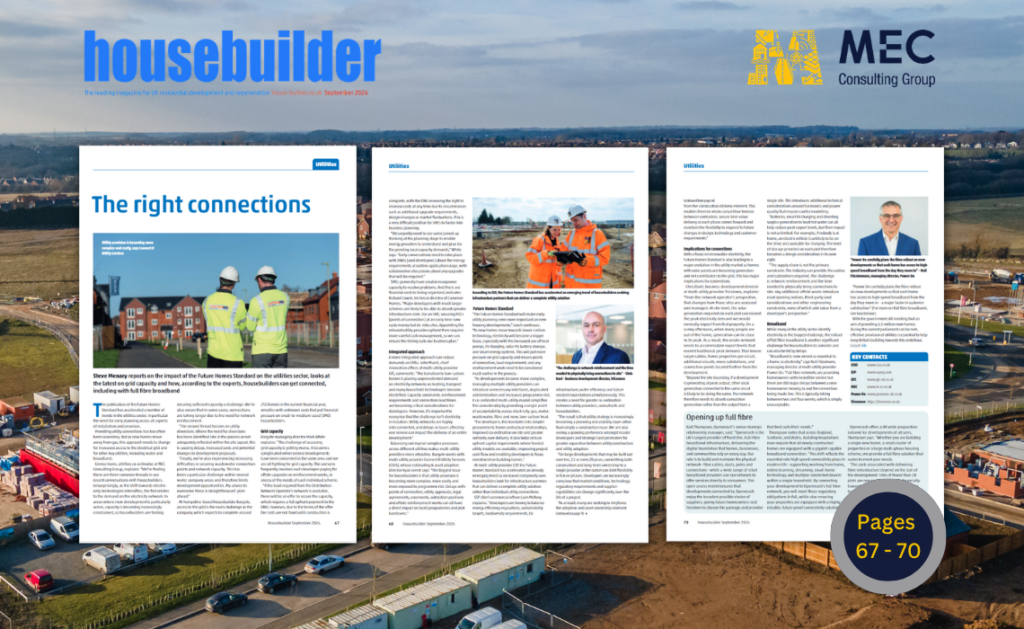
Our Utilities team recently featured in the September edition of Housebuilder Media, where our Senior Utilities Co-ordinator Emma joins the discussion on the impact of The Future Homes Standard on the utilities sector…
What are the biggest issues in terms of utilities for housebuilders?
We’re finding there are three common threads in our recent conversations with housebuilders. Unsurprisingly, as the shift towards electric-only technologies intensifies, the first relates to the demand on the electricity network. In areas where new development is particularly active, capacity is becoming increasingly constrained, so housebuilders are finding securing sufficient capacity a challenge. We’re also aware that in some cases, connections are taking longer due to the need for network reinforcement.
The second thread focuses on utility diversions. Where the need for diversions has been identified late in the process or not adequately reflected within the site layout, this is causing delays, increased costs and potential changes to development proposals.
Finally, we’re also experiencing increasing difficulties in securing wastewater connection points and network capacity. This has been a particular challenge within several water company areas and therefore limits development opportunities.
My advice to overcome these is straightforward. Plan ahead. The earlier a constraints plan and asset searches can be commissioned, the more informed you’ll be. Ideally these surveys should be undertaken during land acquisition discussions, as this will avoid having to rearrange masterplans or layouts, and will confirm associated timescales, which is crucial for both financial planning and the overall duration of development works.
Are these better/worse for SME housebuilders rather than the major players?
It’s hard to be that definitive. Infrastructure capacity is an issue that all developers are likely to encounter. We expect capacity constraints to remain a key issue for larger developments, so anything over 100 units, as these typically place greater demand on existing infrastructure. Smaller developments, anything from 10-100 units, may be able to proceed without significant constraints, however, this is highly dependent on their location and scale.
Is grid capacity getting better or worse?
I think it’s fair to say that infrastructure capacity constraints are becoming more pronounced, although this has been a gradual trend rather than a sudden change. Electricity network operators are actively investing in upgrades and have programmes in place to increase capacity to support future development. However, there is an inevitable lag between the demand for new connections and the completion of reinforcement works, which take considerable time to plan and deliver. As a result, housebuilders are urged to forward plan and allow sufficient time for these infrastructure improvements to be delivered before development can proceed.
How has the publication of the Future Homes Standard helped/hindered housebuilders re utilities?
The FHS outlines a goal to achieve a 75% reduction in carbon emissions for new homes, compared with those built to the 2013 Building Regulations standard. This has provided greater certainty regarding the commitment to electric technologies, which helps housebuilders plan for the future.
However, it also means developers need to consider the specification of building materials, heating systems and energy-efficient design measures far earlier in the process than has traditionally been the case. This has placed greater emphasis on coordination between design teams, consultants and utility providers, which is a positive. That said, differing interpretations by local authorities and the additional time required at the planning and design stage continue to present challenges, so there are certainly still barriers to overcome.